[Paper Reading] Security Analysis of Tesla Vehicles' LTE Connectivity: Fake Base Station Attacks and Connection Recovery
WOOT '26 paper review | Security Analysis of LTE Connectivity in Connected Cars: A Case Study of Tesla
Table of Contents
1. [Vehicle LTE/TCU Connectivity Architecture]
2. [Attacker Model and Experimental Setup]
3. [Fake Base Station Attack Analysis]
4. [TCU Behavior at Different Connection Failure Stages]
5. [SMS, Emergency Alerts, and Security Algorithms]
6. [Observations from an Automotive Red Team Perspective]
7. [Conclusion]
I've recently been studying LTE, and this paper is closely related to the work I'm currently doing, so I decided to review it. The successful attack against Tesla's LTE modem at Pwn2Own Automotive 2024 also sparked my interest in the subject.
This is my first paper review, so I may have misunderstood some details or left certain explanations unclear. If you spot any mistakes, please feel free to point them out.
Introduction
If a vehicle selects a fake LTE base station but fails authentication, will it look for another cell? If the fake base station disappears, will the vehicle reconnect to the legitimate network?
The WOOT '26 paper Security Analysis of LTE Connectivity in Connected Cars: A Case Study of Tesla investigates these questions using a Model 3 and a Cybertruck. The researchers set up a fake base station broadcasting the same PLMN as a mobile operator and observed NAS messages exchanged before authentication. In separate experiments, they also examined how the TCU behaved after Attach and data connectivity failures.
One of the most notable findings concerns connection recovery. In an experiment using a fake base station that matched the PLMN configured on the vehicle's physical SIM, the vehicle could not access normal data services. It did not recover its connection during approximately 15 minutes of fake-base-station transmission. Even after the transmission stopped, no automatic reconnection was observed for another approximately 10 minutes. Normal connectivity returned only after a manual reboot.
Identifier exposure was tested with both a commercial eSIM and physical SIMs. However, the researchers did not separately establish whether the same recovery failure would occur with the default eSIM or on public roads. The following sections distinguish these experimental conditions.
1. Vehicle LTE/TCU Connectivity Architecture
1-1. The TCU and External Communication Path
 Figure 1. The TCU inside the vehicle communicates with external networks through an LTE base station. The owner app sends requests to the vehicle through the manufacturer's servers.
A vehicle's LTE modem communicates wirelessly with a base station (eNodeB), then reaches the manufacturer's servers through the operator's core network (EPC). The owner's app also generally sends requests through the manufacturer's servers; it does not connect directly to the LTE modem.
The TCU (Telematics Control Unit) is an in-vehicle control unit responsible for external communications through the LTE modem. The vehicles in this study contain an LTE modem and embedded eSIM, and their external connectivity is also affected by vehicle software policies. Rather than reverse-engineering the modem firmware, the paper examines connection and recovery behavior observable from outside the vehicle. The recovery problem therefore cannot be attributed to a specific modem firmware defect based on these results alone.
Even with a physical SIM installed, the vehicles preferred the embedded eSIM by default. The researchers enabled a research physical SIM to conduct separate experiments on their private LTE network.
 Figure 2. The LTE modem and physical SIM slot in the Model 3. The researchers installed a SIM for their private test network in this slot. Figure 8 in the paper.
The researchers checked SIM and network registration states in the vehicle's Service Mode and compared them with test-network logs.
 Figure 3. Model 3 Service Mode showing a connection to the private LTE network using a research physical SIM. Figure 14 in the paper. This screenshot does not show the default eSIM configuration.
1-2. LTE Connection Stages and Observation Points
In LTE, the vehicle modem acts as user equipment (UE), much like a mobile phone. It first selects a cell broadcasting a PLMN ID (a combination of MCC and MNC), establishes an RRC (Radio Resource Control) connection, and then performs network registration and authentication through NAS (Non-Access Stratum) procedures. A matching PLMN ID does not, by itself, establish that the base station is legitimate.
An RRC connection only establishes the ability to exchange control messages with the base station. Even if subscriber authentication succeeds during NAS Attach, the vehicle still needs an IP address and data path through PDN connectivity, as well as responses from Tesla's servers, for its services to function. In LTE, Attach and PDN setup can be performed as part of the same procedure.
| Stage |
What Can Be Verified |
What This Stage Alone Cannot Establish |
| Cell selection / RRC |
Base station selection and control-message exchange |
Successful subscriber authentication |
| NAS Attach |
Network registration and authentication |
A working IP path |
| PDN |
IP address and data path |
Whether Tesla's servers respond |
| Server communication |
Connectivity to the manufacturer's servers |
Whether individual remote functions work correctly |
Table 1. Criteria for distinguishing connection failure points. A `Registered` status in Service Mode does not mean that communication with Tesla's servers has succeeded.
In this review, IMSI refers to the subscriber's long-term identifier, GUTI to a temporary identifier assigned by the mobile network, and IMEI to the device identifier. The researchers correlated base-station RRC/NAS logs and packet captures with the vehicle's `Network Registration`, `Data Registration`, and `Cell Link State` values in Service Mode.
2. Attacker Model and Experimental Setup
2-1. Attacker Model and Test Vehicles
The paper distinguishes between A1, an attacker who passively observes radio signals, and A2, an attacker capable of transmitting radio signals. A2 can deploy a fake LTE base station that impersonates an operator's PLMN and participate in the vehicle's pre-authentication control procedures. However, the model assumes that the attacker has no access to the commercial eSIM's long-term authentication keys, Tesla account or server privileges, or the vehicle's internal systems.
The test vehicles were US-specification 2024 Tesla Model 3 and Cybertruck vehicles. Both used a Quectel AG525R-GL LTE modem. The researchers did not modify the modem firmware or obtain administrative access to the vehicles. Instead, they observed connection behavior through external LTE infrastructure and vehicle diagnostic interfaces.
2-2. LTE Test Network and SIM Configuration
The researchers built a private LTE test network using Amarisoft Callbox Classic, srsRAN, and a USRP B210 SDR. They used these systems to test normal network registration and data connectivity as well as connection failures induced by fake base stations. Both Amarisoft and srsRAN were used in the IMSI exposure experiments.
To register the vehicle on their private network, the researchers configured a programmable sysmocom sysmoISIM-SJA5 SIM with PLMN and subscriber authentication parameters matching those in the core network. This was a research SIM; it did not involve extracting authentication keys from Tesla's commercial eSIM. Unlike the external attacker described in the threat model, the researchers could directly control the test physical SIM (pSIM) and the authentication configuration of their EPC.
Because the vehicle used its embedded eSIM by default, the researchers installed a test SIM in the TCU's physical SIM slot and disabled the eSIM using Tesla Toolbox. The test vehicles did not support activating both SIMs simultaneously. When replacing a SIM, the researchers performed a hard reboot by disconnecting and reconnecting the 12 V battery, restoring power to reset the communication state. The paper does not specify the exact manual reboot procedure used later in the FBS recovery experiment.
The main equipment and experimental conditions were as follows.
| Category |
Setup |
| Test vehicles |
2024 Tesla Model 3 and Cybertruck (US specification) |
| LTE modem |
Quectel AG525R-GL |
| LTE test network |
Amarisoft Callbox Classic, srsRAN |
| SDR |
USRP B210 |
| SIM |
Commercial eSIM, research physical SIM (pSIM) |
| RF shielding |
Faraday tent with approximately 93 dB shielding effectiveness |
| Observation tools |
Wireshark, tcpdump, Tesla Toolbox, Service Mode |
Experimental setup summary. The SIM and core-network configurations differed depending on the experiment.
The conditions of the individual experiments also need to be distinguished.
| Experiment |
SIM / Network Conditions |
Observed Result |
| Pre-authentication identifier exposure |
Commercial eSIM or pSIM; fake base station with matching PLMN |
IMSI/GUTI exposure |
| Fake-base-station camping and recovery |
Fake base station broadcasting the PLMN of the vehicle's physical SIM |
Partial attach and no automatic recovery during the observation period |
| Attach / PDN / IP failures |
Research pSIM and researcher-controlled EPC |
Retries and data connectivity behavior at different failure stages |
| PLMN acceptance |
PLMN values changed together on the pSIM and test network |
Difference between network registration and service activation |
Experimental conditions summary. In particular, the last three experiments should not be treated as equivalent to externally triggered attacks against the commercial eSIM.
2-3. RF Shielding and Observation Methods
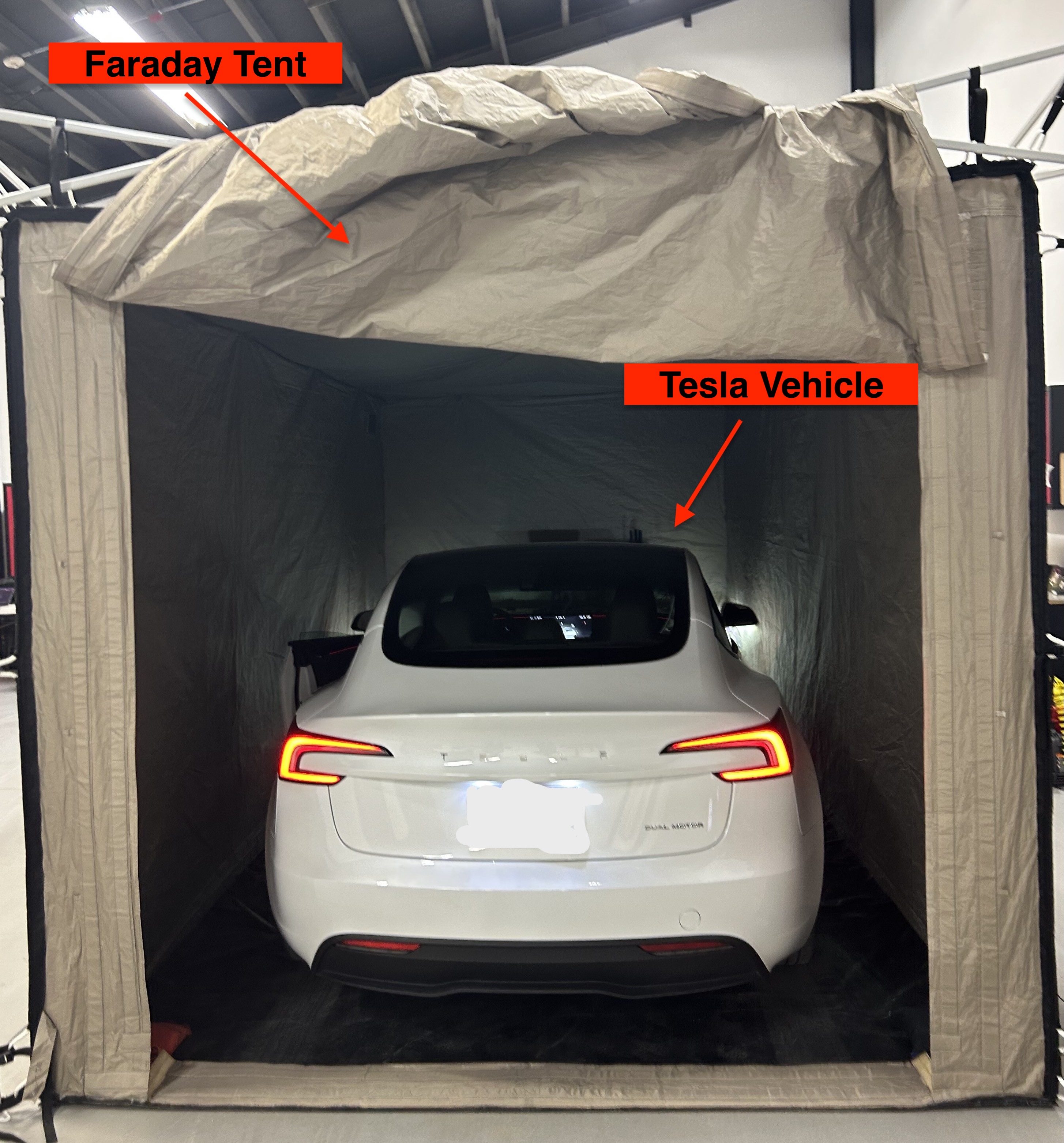
 Figure 4. The RF-shielded tent containing the vehicle and the experimental equipment. The second photo shows the laptop and USRP, Amarisoft system, test smartphones, and SIM cards. Figures 1(a) and 1(b) in the paper.
The experiments were performed with the vehicle and radio equipment inside a Faraday tent providing approximately 93 dB of shielding effectiveness. Placing the entire vehicle inside a shielded space reduced interference from commercial base stations and made it possible to test which cell the vehicle selected. It also helped prevent the test base station's signals from radiating outside the setup. Before configuring the test network, the researchers surveyed nearby commercial networks, including their PLMNs, frequencies (EARFCNs), LTE bands, and signal quality, and aligned the radio settings of the test network accordingly.
Before connecting the Teslas, the researchers verified the test network using iPhone and Android smartphones. They checked whether the PLMN could be discovered, Attach and data connections succeeded, internet access worked, and reconnection was possible. These checks provided a baseline for distinguishing vehicle-side connection failures from basic test-network misconfiguration. A TP-Link AC1750 Wi-Fi router was also placed inside the tent to observe LTE and Wi-Fi connectivity and potential alternative paths. However, the router's presence does not establish that the vehicle successfully performed automatic Wi-Fi fallback.
On the network side, the researchers recorded RRC/NAS messages and IP packets using Amarisoft/srsRAN logs, Wireshark, and tcpdump. They also checked test-network connectivity with `ping`, `traceroute`, and `iperf`. On the vehicle side, they inspected SIM, network registration, and data connectivity states through Tesla Toolbox and Service Mode. Most traffic to Tesla's servers was TLS-encrypted, so destinations and responses could be observed, but the contents of requests could not be read. The transmission gain varied in these experiments was an equipment setting and cannot be directly converted into an attack range on public roads.
3. Fake Base Station Attack Analysis
3-1. Pre-Authentication IMSI and GUTI Exposure
The researchers observed pre-authentication NAS messages when the fake base station broadcast the same PLMN as the SIM profile. In LTE, a base station can send an `Identity Request` asking for the IMSI before authentication, and the UE may return its IMSI in an `Identity Response`. Figures 3(a) and 3(b) of the paper show this request-and-response exchange.
The GUTI is a temporary identifier assigned by the mobile network. Table 1 of the paper reports IMSI/GUTI exposure, while Figure 3 provides an example of IMSI retrieval. The table alone does not establish that both identifiers appeared in the same NAS message.

 Figure 5. Packet captures showing the NAS Identity Request/Response exchange and IMSI exposure between the fake base station and vehicle. The screenshot displaying an IMSI comes from a test using a research physical SIM. Figures 3(a) and 3(b) in the paper.
According to Table 1 in the paper, IMSI/GUTI exposure was observed for both a commercial eSIM and a physical SIM with a matching PLMN when the fake base station broadcast `310260`. It was also observed with a matching physical SIM when the base station broadcast `310150`. In contrast, when the SIM was configured for `310260` and the fake base station broadcast the test PLMNs `00101` or `99970`, the vehicle did not attach and the identifiers were not obtained. Each condition was tested ten times, and no IMEI exposure was observed.
These results demonstrate pre-authentication identifier exposure. They do not show that the fake base station successfully provided normal data services or decrypted TLS traffic. The paper also discusses the possibility of GUTI-based tracking, but it did not measure identifier lifetime or demonstrate long-term tracking in practice.
3-2. Partial Attach and Failure to Recover Service
For the recovery experiment, the researchers used a fake base station broadcasting the same PLMN as the physical SIM referred to in the paper as `Tesla's native physical SIM`. The paper does not separately identify the exact type of physical SIM used in this experiment. The vehicle selected the cell and exchanged RRC/NAS messages, but subscriber authentication did not complete, so it could not access data services. The paper calls this a partial attach. The reported success counts therefore refer to inducing this partial connection state, not establishing working LTE service.
| Fake Base Station DL Gain |
0 dB |
−5 dB |
−10 dB |
−15 dB |
| Partial attach attempts induced |
10/10 |
10/10 |
10/10 |
9/10 |
| Time-to-Attach |
~2 s |
~2 s |
~2.5 s |
~4.5 s |
| Connection duration |
~4 s |
~4 s |
~4 s |
~4 s |
| Reattach / Camp |
Camps |
Camps |
Camps |
Camps |
Table 3. Fake-base-station experiment using the same PLMN as the vehicle's physical SIM (Table 2 in the paper). Success refers to inducing a partial attach rather than obtaining a working service connection. `Camps` indicates that the vehicle remained camped on the cell. DL gain is a hardware configuration value, not a direct measure of attack distance or received power.
Even when the fake base station broadcast a matching PLMN, its signal had to be strong enough for the vehicle to select that cell. Reducing transmission gain increased the time taken to attempt a connection to the fake cell, while connection duration remained close to four seconds. The vehicle did not show a separate visual or audible warning to the driver when it switched over.
While the vehicle remained on the fake cell, its connections to Tesla's servers were also disrupted. It did not return to the legitimate network during roughly 15 minutes of fake-base-station transmission, nor did it reconnect during approximately 10 minutes after transmission stopped. Connectivity was restored only after a manual reboot. This describes what was observed during the test period, not proof that the vehicle would never reconnect given more time.
The researchers also adjusted transmission signals to create conditions resembling a transition between cells. The vehicle attempted to retain its existing security and session context, but the fake cell could not continue the session, resulting in connection loss. Retaining an existing context is not inherently a vulnerability. The noteworthy behavior was the absence of an observed return to the legitimate network after the transition failed. This was a test inside a shielded environment, not an on-road handover experiment.
 Figure 6. Packet trace related to Tesla services collected during the fake-base-station experiment. Figure 4 in the paper.
Figure 6 includes QUIC, TLS, and TCP packets associated with Tesla services, along with retransmissions and connection termination packets. The paper presents this trace as an example of degraded service communication during the fake-base-station attack. Under normal conditions, bidirectional TCP traffic was observed during actions such as loading a driver profile or interacting with the vehicle. However, because most traffic was TLS-encrypted, the exact failed requests could not be identified. The researchers also did not experimentally trigger and verify failures of specific functions such as remote unlocking or OTA updates.
Figure 17 in the paper shows repeated Random Access and RRC connection attempts in the attacker's base-station logs. Figure 18 shows the disappearance of the vehicle's connection and failed paging attempts in the legitimate-network logs. Together, these logs illustrate what each side of the radio network observed during the fake-base-station experiment.
4. TCU Behavior at Different Connection Failure Stages
4-1. Attach, PDN, and IP Forwarding Failures
A failure involving a fake base station alone does not isolate whether the Attach, PDN, or IP forwarding stage affected the TCU's retry and recovery behavior. To separate these cases, the researchers built a pSIM/EPC test network capable of successful registration and then deliberately introduced failures at different stages. These experiments focused on how the vehicle handled failures. PDN and IP forwarding tests used conditions in which the researchers controlled successful authentication and data connectivity, unlike pre-authentication Attach rejection.
| Failure Stage |
Condition Introduced on the Test Network |
Vehicle Response |
| Attach / Authentication |
PLMN Not Allowed, EPS Services Not Allowed, Unknown UE, MAC Failure, etc. |
Generally retried at least five times, then stopped or stayed camped on the cell |
| PDN / APN |
Missing or Unknown APN, Unknown PDN Type, PDN Type IPv4 Only Allowed, etc. |
In several conditions, remained on the cell without establishing a working data path |
| IP Routing |
Allowed Attach and PDN setup, then blocked NAT/forwarding |
Continued sending requests to the server without receiving responses |
Table 4. Summary of the failure conditions in Section 5 and Table 3 of the paper. The researchers reported that randomized backoff was not observed during repeated connection attempts.
The NAS control-procedure experiments included PLMN Not Allowed, EPS Services Not Allowed, Unknown UE, MAC Failure, and Missing or Unknown APN. The PDN connection experiments also used rejection causes such as Unknown PDN Type and PDN Type IPv4 Only Allowed. The paper lists these as failure conditions; identifying the exact message associated with each cause would require examining the corresponding logs.
The IP forwarding experiment was different. After allowing Attach and PDN setup to succeed, the researchers modified NAT/routing rules. The vehicle continued sending packets toward the servers but received no responses. No automatic switch to another PLMN or to Wi-Fi was observed. However, the default eSIM was disabled during the test, and it was unclear whether Wi-Fi had been configured as a functioning alternative path. The result therefore should not be generalized as proof that every fallback mechanism failed. It shows that radio-network registration and actual service connectivity can diverge.
### 4-2. PLMN Selection and Service Activation Policies
In the identifier experiments in Section 3-1, the vehicle did not attach when a fake base station broadcast `00101` or `99970` while the SIM profile remained configured for `310260`. In a separate PLMN acceptance experiment, however, Attach and PDN setup proceeded using these test PLMNs. The difference is that the first experiment kept the SIM configuration unchanged, while the second changed the PLMN settings on both the pSIM and the core network.
Even if network registration and PDN connectivity succeeded on a test PLMN, vehicle services did not necessarily become active. The researchers checked `Valid SIM`, `Valid IMEI`, `Network Registration`, `Data Registration`, and `Cell Link State` in Service Mode. In particular, they needed to separately verify whether `Cell Link State` changed to `Online` and whether server communications worked. The paper interprets this distinction as potentially related to Tesla's allowed-operator or roaming policies, but it did not identify which software component implements the decision logic.
## 5. SMS, Emergency Alerts, and Security Algorithms
### 5-1. SMS and Emergency Alerts
SMS and emergency alerts use different delivery paths. The researchers sent ordinary text SMS messages through IMS (IP Multimedia Subsystem) and checked whether the vehicle received them. SMS reception appeared in the protocol records, but no text message was displayed on the vehicle's screen. The researchers did not observe how the messages were handled inside the TCU. Malformed SMS, binary SMS, and silent SMS were outside the test scope.
These experiments were conducted on the private LTE network. The paper discusses the possibility of sending SMS through a commercial operator's network if the vehicle's phone number (MSISDN) is known, but it did not test that scenario on a live commercial network.
ETWS (Earthquake and Tsunami Warning System) and CMAS (Commercial Mobile Alert System) emergency alerts are broadcast through base-station paging and system information. The researchers confirmed transmission in base-station logs, but the alerts did not appear as visual or audible warnings to the driver. This alone does not establish whether the TCU received the alerts and suppressed them internally or never received them.
The supported conclusions are therefore that an SMS reception path exists on the vehicle and that transmitted emergency alerts did not result in driver-visible notifications. The experiments did not identify an SMS-based code execution vulnerability or a flaw in the internal alert-processing logic.
### 5-2. 2G Support and LTE Security Algorithms
The modem's advertised capabilities included 2G-related cipher algorithms such as GSM A5/3 and GPRS GEA2/3, as well as SMS support. It also advertised LTE EEA0, which provides no ciphering. However, an attempt to select EIA0, which provides no integrity protection, was met with a `SecurityModeReject` response.
Advertised capabilities must be distinguished from actual network connections. Advertising these features does not mean that the vehicle actually connected to a 2G network or used EEA0 on a commercial LTE network. EEA0 is also a defined Null Ciphering option within LTE. Assessing whether a configuration is vulnerable requires knowing the security state and network settings under which the algorithm would be negotiated. The paper does not demonstrate a successful 2G downgrade attack.
6. Observations from an Automotive Red Team Perspective
6-1. Notable Findings
IMSI catchers and connection disruption through fake base stations are established techniques. What makes this paper interesting is that the researchers connected production-vehicle TCUs to a private LTE network and measured failures at separate stages. By correlating RRC/NAS logs, Service Mode states, and server traffic, they were able to investigate connection issues that cannot be explained by a simple 'registered to the network' indicator.
Pre-authentication IMSI exposure and cell selection based on an impersonated PLMN are related to LTE protocol design. In contrast, prolonged failure to recover after an unsuccessful cell transition, or retaining a connection state when IP communication is unavailable, raises separate questions about the responsibilities of the TCU, modem, and vehicle software. The paper observes externally visible behavior; it does not identify the internal state machine or firmware component responsible.
6-2. Where Did Recovery Fail?
The reason the vehicle did not return to the legitimate network after the fake base station stopped transmitting remains unclear. Table 3 reports `Camps` for every transmission-gain setting, and the attacker's logs show repeated Random Access and RRC connection attempts. These observations alone cannot determine whether the problem involved delayed cell reselection, NAS re-registration timers, or the TCU's connection-management state. The IP forwarding test in Section 4, meanwhile, shows that server communication can fail even after authentication and PDN setup have completed. Because the two experiments fail at different stages, they cannot be reduced to a single cause. The lack of internal logs also limits root-cause analysis.
To distinguish the causes, recovery should not be measured as a single elapsed time. Instead, events should be recorded on a common timeline, starting when the fake cell disappears and continuing through the first cell reselection, RRC connection, NAS registration, IP path establishment, and first server response. The point where this sequence stops determines which implementation needs closer examination.
7. Conclusion
Personally, the most interesting part of this paper was not the attack results but the way the researchers built their experimental environment.
I've previously watched tests being conducted in a small shielded setup for an individual control unit, but I'd never seen an LTE attack tested inside a shielded tent large enough to contain an entire vehicle, as shown in this paper. Using an SDR and a private LTE network to run these experiments against a real car was particularly fascinating, and it was the part I enjoyed reading the most.
Beyond the LTE attack techniques themselves, the paper gave me a chance to see how researchers set up an experimental environment around a complete vehicle. I'd like to try conducting experiments in a similar environment if I get the opportunity.
References
- Evangelos Bitsikas, Jason Veara, Aanjhan Ranganathan, Security Analysis of LTE Connectivity in Connected Cars: A Case Study of Tesla, 20th USENIX WOOT, 2026. [Official presentation page](https://www.usenix.org/conference/woot26/presentation/bitsikas) · [Official PDF](https://www.usenix.org/system/files/woot26-bitsikas.pdf) · [arXiv HTML version](https://arxiv.org/html/2510.22024v3)
- The photographs and packet-capture images used in this post come from the paper's [public arXiv HTML version](https://arxiv.org/html/2510.22024v3), with the corresponding paper figure numbers identified in the captions. The public version indicates a CC BY 4.0 license. The Mermaid diagram (Figure 1) was created separately for this review.
- [Experimental packet traces released by the researchers (Zenodo)](https://doi.org/10.5281/zenodo.19699792)
- This post was written with the assistance of an LLM.