How Japan Is Putting AI Agents to Work in Security
Contents
- Introduction
- SUGI: A Security LLM That Never Sends Data Outside
- Takumi byGMO: An AI Agent Specialized in Security Work During Development
- Closing Thoughts
- References
Introduction
AI-powered security products and companies are on the rise. In Korea, there is Xint by Theori. So what is out there in Japan, a country so close, yet so far?
This post looks at two security AI agents from Japan. One is SUGI from Ikotas Labs, which works without sending data outside, and the other is Takumi byGMO from GMO Flatt Security, which specializes in security work during development. Based on public materials and screenshots, I summarize what each tool does and how it actually works.
SUGI: A Security LLM That Never Sends Data Outside
 Ikotas Labs logo. Source: Ikotas Labs press release
SUGI is a fully local LLM product announced by Ikotas Labs on August 25, 2026, that supports web application vulnerability assessment and forensics (Ikotas Labs announcement). Ikotas Labs is a Tokyo-based security company led by Satoki (Tomoki Tsuji), and it is also the team that won Master of Pwn at Pwn2Own Ireland 2026. However, whether SUGI was used in that competition has not been disclosed.
 SUGI start screen. Source: Ikotas Labs announcement
Features
- Architecture: An LLM built on an open-weight model and tuned for the security domain, integrated with the company’s own CLI agent, originally developed for frontier models, all the way down to the execution harness. Both a CLI and an API are provided.
- Data handling: Source code, logs, and intermediate outputs are not sent to external clouds or LLM providers, and it also works in air-gapped environments. In the standard configuration, it can be operated with network access blocked on the host running SUGI, and if needed, it can be adjusted to allow access to search engines only.
- Target sectors and delivery: It targets sectors where data is hard to send outside, such as healthcare and pharmaceuticals, finance, public sector and defense, and incident response. It is delivered with hardware or deployed on the customer’s infrastructure. The company also states that it can offer an Uncensored option with the model’s safety checks disabled, subject to review and an individual contract, only for uses where standard safety filters get in the way of the work, such as offensive vulnerability research, red team exercises, and analysis of real malware.
- Performance: The company states that in internal evaluations it confirmed performance close to frontier models on web vulnerability assessment and forensics tasks. No external validation results have been published.
Case 1: Solving a CTF Pwn Challenge
As a real example from its internal evaluation, the company published a screenshot of SUGI autonomously solving a CTF Pwn (binary exploitation) challenge and obtaining the flag.
 SUGI autonomously solving a CTF Pwn challenge and obtaining the flag. Source: Ikotas Labs announcement
Case 2: Restoring the Screen from a RAM Dump Alone
On September 7, 2026, Satoki posted a video on X showing SUGI performing autonomous forensics (X post). Given only a single memory dump file, memory.elf, SUGI analyzed its ELF structure, scanned the entire 6.2 GB, and from the screen candidates it found, picked a 1280×800 Windows 11 desktop and restored it as an image. When its first search failed, it identified the cause and fixed it, and at the end it checked the color order and orientation of the restored image before writing up its investigation steps in a report. According to the post, it used the Google logo as a simple color chart, and the video includes sped-up segments.
 Windows 11 desktop restored by SUGI from a RAM dump. Source: Satoki’s video on X
Takumi byGMO: An AI Agent Specialized in Security Work During Development
 Takumi byGMO logo. Source: GMO Flatt Security press release
Takumi byGMO is a security AI agent launched in March 2025 by GMO Flatt Security, a GMO Internet Group company (GMO press release). When you add it to Slack and ask for a security review as you would a fellow security engineer, it works through trial and error on its own for several minutes to tens of minutes and reports the results. The base price is 70,000 yen per month (excluding tax), and the company says more than 300 organizations have adopted it (Takumi byGMO official page).
Features
- Vulnerability assessment: Supports white-box assessment (SAST), which reads source code, and black-box assessment (DAST), which dynamically attacks a given URL. The company explains that, unlike conventional tools centered on pattern matching, it understands the application’s specifications and business logic to find risks specific to that implementation.
- Auto-fix and AI penetration testing: Submits fix patches for detected vulnerabilities as Pull Requests, along with unit tests and a report, and also offers an AI penetration testing feature.
- Development environment protection: Also offers Takumi Guard, which blocks malicious packages; Takumi Runner, which makes CI/CD activity visible; and Takumi Images, which protects container environments (GMO Flatt Security press release, Takumi Images press release).
- Performance: In a 10-day proof of concept, it found 10 zero-day vulnerabilities, and it discovered and reported a vulnerability in Vim.
- Domestic inference option: In the standard service, AI inference requests go to an inference provider in a region outside Japan. Starting November 2, 2026, a paid option lets inference also be completed on infrastructure inside Japan, in which case source code, requests, responses, and credentials are not sent outside the country (GMO Flatt Security press release).
 Without the domestic inference option: inference requests go to an inference provider in a region outside Japan. Source: GMO Flatt Security press release
 With the domestic inference option: inference is completed within a region in Japan. Source: GMO Flatt Security press release
Screens from Actual Use
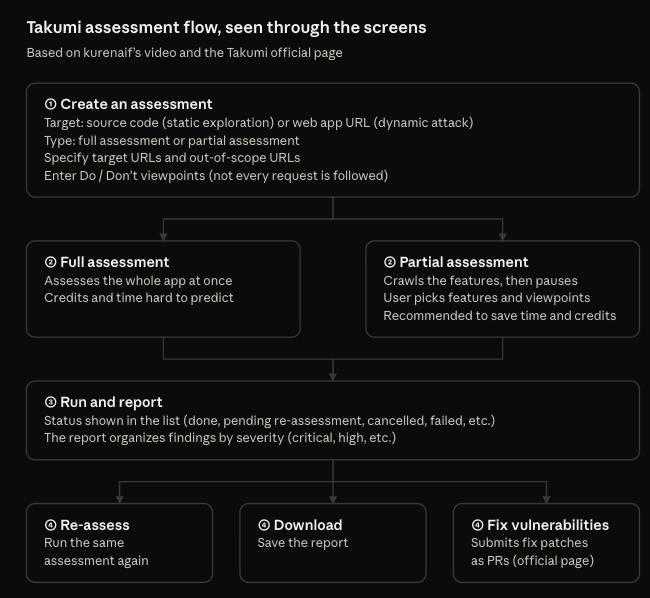
The YouTube channel kurenaif published a sponsored video (marked 【PR】 in its title) trying out Takumi firsthand (YouTube). Putting the screens from the video in order gives the following flow.
 Assessment creation screen: choose the assessment target (source code or web app URL) and the assessment type (full or partial). Source: kurenaif YouTube
 Part of the findings list in an assessment report: path traversal, SQL injection, stored XSS, and more are organized by severity. Source: kurenaif YouTube
Closing Thoughts
In this post, we looked at AI agents from Japan. Not only in Korea but also in Japan, research and product development that apply AI to security are underway, as seen in Ikotas Labs’ SUGI and GMO Flatt Security’s Takumi byGMO.
I wrote this post hoping that we pay attention not only to research in Korea but also to research abroad. My Japanese is limited, but I did my best to research and organize this. Thank you for reading!
References
- Theori Xint interview (Theori blog, Korean)
- SUGI launch press release (Ikotas Labs, distributed via PR TIMES, 2026-08-25)
- SUGI service launch (Ikotas Labs, 2026-08-25)
- SUGI forensics demo video (Satoki on X, 2026-09-07)
- Pwn2Own Ireland 2026 first place (Ikotas Labs, 2026-10-12)
- Takumi launch press release (GMO, 2025-03-24)
- Takumi byGMO official page (GMO Flatt Security)
- Takumi byGMO software supply chain attack protection press release (GMO Flatt Security, distributed via PR TIMES)
- Takumi Images launch press release (GMO Flatt Security, distributed via PR TIMES)
- Takumi byGMO domestic inference option press release (GMO Flatt Security, distributed via PR TIMES)
- AI診断、たくさんあるけど実際どう? (“There are lots of AI assessments, but how are they really?”) (kurenaif YouTube, 【PR】)